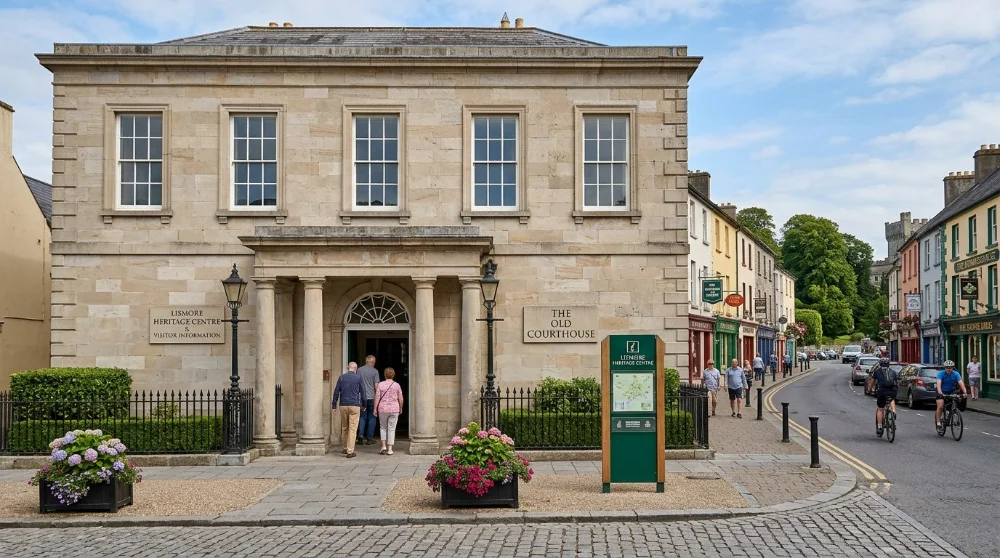
The Old Courthouse on Main Street
Where Lismore’s Stories Find a Voice
The building sits on Main Street, solid and unassuming, a neoclassical presence that has watched over Lismore for more than two hundred years. Built in 1815, it was commissioned by William Cavendish, the 6th Duke of Devonshire, whose seat was at Lismore Castle. The architect was John Carr, a Yorkshireman who designed country houses and public buildings across Ireland and England. The Sessions House, as it was then called, followed a pattern common in Irish market towns: the ground floor held the market hall, where traders and farmers gathered, and the courtroom sat above.
In 1855, the building took on a new role as a town hall. But the courtroom remained. The law was dispensed here for generations. Then came the War of Independence, and in the chaos of those years, the courthouse was burned. The building rose again from the ashes, rebuilt shortly afterwards. Marks of that fire can still be seen on some of the stonework.
The courthouse served its purpose until the 1990s, when the courts moved elsewhere. The building stood empty, its future uncertain. That was when a group of people in Lismore looked at the old Sessions House and saw something else. They saw a place where the town’s story could be told.
A New Beginning
In 1992, the Lismore Heritage Centre opened its doors. The courthouse had become a centre for visitors, a place where people could come and learn about the town’s long and remarkable history.
The location made sense. Lismore sits at the foot of the Knockmealdown Mountains, a town with a castle that dates back to 1185 and a history that reaches even further. St Carthage established a monastery here in 636. The Irish High Kings studied alongside saints and scholars. King John built the castle to guard the river crossing. The Normans came, and Cromwell, and the Vikings before them. There was so much to tell, and this old building, with its own layers of history, was the perfect place to tell it.
The centre had another important function. It became the town’s Tourist Information Point. Visitors arriving in Lismore could walk through the doors on Main Street and find someone who could answer their questions, point them in the right direction, help them make the most of their stay. The staff knew the town. They knew the walks and the history and the best places to eat. They still do.
The Exhibition Galleries
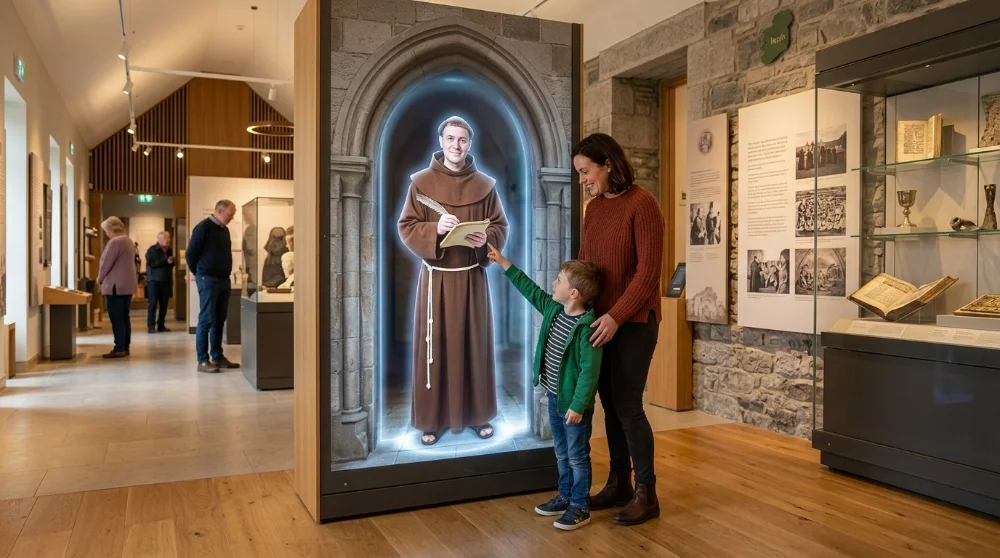
Walk through the centre today and you step into a different world. The exhibition galleries have been designed to bring the past to life. Here, you come face to face with the people who shaped Lismore through the ages. The figures are not just names on a wall. They speak to you, tell you their stories, draw you into their world.
There is St Carthage, who came to this place in the seventh century and built his ‘Lios Mór’ – the great fort – on the bank of the river. There are the scholars who made Lismore a university city, attracting students from across Europe. There is Sir Walter Raleigh, who owned the castle for a time. There is Robert Boyle, born in Lismore Castle in 1627, the father of modern chemistry. And there is the Book of Lismore, a medieval manuscript hidden in the castle walls for two hundred years, discovered by workmen in 1814.
The exhibitions use audio-visual media to tell these stories. A figure known as ‘Brother Declan’ guides visitors through the galleries. It is immersive, engaging, and it does not feel like a museum. It feels like a conversation.
The Robert Boyle Legacy
Robert Boyle is a constant presence at the Heritage Centre, and it is easy to see why. He was born in Lismore Castle in 1627. He is considered one of the founders of modern experimental science. His work on the relationship between gas pressure and volume – Boyle’s Law – is still taught in schools today. The centre celebrates his legacy in ways that are both educational and fun.
The VR Experience
In the shadow of the castle, the Heritage Centre offers something that no other place can. Lismore Castle is a private residence. The Cavendish family, the Dukes of Devonshire, still live there. The public cannot simply walk through the front gates and explore the rooms. But the Heritage Centre has found a way to let people see inside.
The Lismore Castle Experience is a virtual reality tour. You put on a headset, and suddenly you are inside the castle. You walk through the beautiful rooms and halls. You see the chapel that was turned into a dining room, the luxurious bedrooms, the ballroom where Fred and Adele Astaire danced all night. Robert Boyle himself narrates the story, guiding you through the centuries. You hear about the famous faces who have graced these halls: Adele Astaire, the Broadway performer who lived here; Kathleen Kennedy, sister of John F. Kennedy; Sir Walter Raleigh and the Earl of Cork and the Dukes of Devonshire. And you hear about the hidden treasures, the Book of Lismore and the Lismore Crozier, forgotten for two hundred years and then discovered by chance.
A local guide is always on hand to answer questions. The experience is exclusive, a privileged glimpse into a world that is otherwise closed.
The Escape Room
For those who prefer their history with a side of adrenaline, there is the Robert Boyle Escape Room. The premise is simple. You are locked in a room. You have sixty minutes to find the clues, crack the codes, and get out. The room is named after Lismore’s most famous scientist, but the themes change regularly. It is suitable for all ages and fun for the whole family.
The escape room is a clever way to teach science. It is one of the only heritage centres in Ireland that uses this approach. You do not just learn about Robert Boyle. You become part of his world, if only for an hour.
Walking the Town
The Heritage Centre also offers guided walking tours of Lismore. These tours run daily. A local guide leads you through the streets, sharing the stories that make this town special. You learn about the monks and the dukes, the scholars and the soldiers. You see the places where history happened. The tours can be themed, depending on your interests.
For those who prefer to explore at their own pace, there are Family Fun Packs. These are treasure hunt trails that lead you on a self-guided tour of the town. It is a way to keep children engaged, to turn a walk into an adventure.
A Centre for the Community
The Heritage Centre is not just for tourists. It belongs to the people of Lismore as well.
Meeting Rooms
The old courthouse has several rooms available for hire. Community groups use them for meetings, for exercise classes, for wellness workshops. The Lismore Dramatic Society calls the Courthouse Theatre home, putting on amateur dramatic performances every year. The space has hosted festivals like Immrama, the Festival of Travel Writing, and Towers and Tales. It has been the venue for the launch of Lismore Castle Arts’ annual programme. The Robert Boyle Summer School, organised by the Heritage Centre in partnership with South East Technological University, takes place here. Irish dancing classes, Men’s Shed meetings, yoga sessions, meditation groups – the building is always busy, always alive with activity.
A Place to Shop
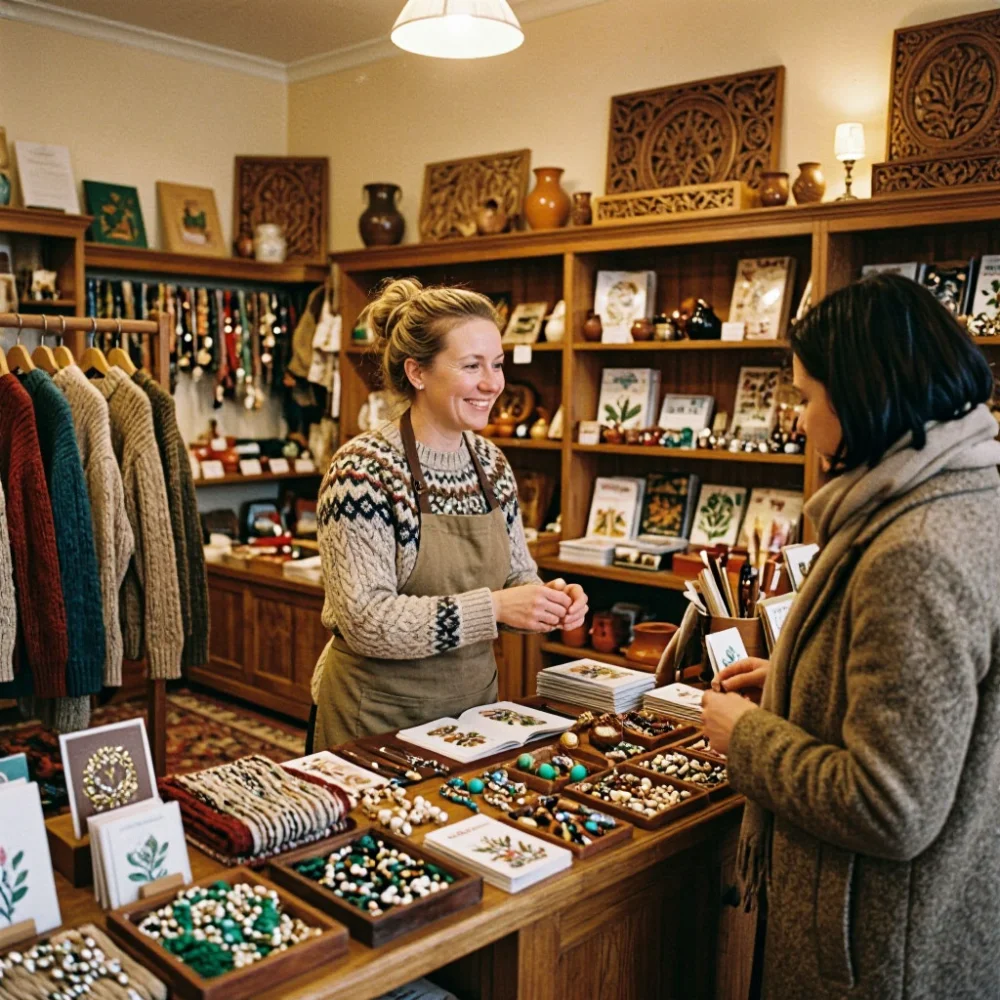
The centre’s gift shop is a showcase for local crafts. This is where you pick up postcards and souvenirs, where you find something to take home that reminds you of Lismore. The staff in the Tourist Information Office are there to help with any questions, any recommendations, any practical needs.
Education and Outreach
The Heritage Company runs education packages from the centre. Hundreds of children visit Lismore each summer on school tours. The school tours operate in May and June. There are modules like ‘Horrible History’ and ‘Scribble Squad’ and ‘Woodland Wanderers’. The programmes are hands-on, engaging, and designed to make learning fun.
But the education team does not wait for schools to come to them. They go out to the schools. The Mobile Science Workshops reach children in their own classrooms. The Mobile Scientists have been visiting schools for more than twenty years. They offer workshops in astronomy, chemistry, forensics, engineering, and Antarctic exploration. They work with primary and secondary students, from Junior Infants right up to the Senior Cycle. The workshops are interactive, hands-on, and designed to bring science to life.
There is also the Robert Boyle Summer School and Winter School, organised in partnership with Calmast and the Royal Dublin Society. These events celebrate the legacy of Lismore’s most famous scientist and promote science education to a wider audience.
A Building with Secrets
In 2014, the Heritage Centre underwent a renovation. Construction workers uncovered something unexpected. A stone archway appeared, unmarked on any plans. Initial estimates suggested it predated the Sessions House. Marks on the stone told a story: fire damage from the War of Independence, and older marks too, hollows and dents where swords might have been sharpened. The arch could have dated from the 1700s.
Mealla Fahey, the centre’s manager, admitted it was a surprise. The arch was load-bearing, so it could not be disturbed. Once uncovered, it turned out to be a beautiful piece of stonework, and the centre decided to keep it exposed as a feature of the redesigned building.
The building, it turns out, still has secrets to share.
A Place for Groups
Groups and clubs wishing to visit Lismore are invited to contact Alice, who organises what the centre calls a Great Day Out. The idea is simple. The centre packages all the area’s attractions into one tailor-made outing. You do not have to worry about the logistics. The centre takes care of everything, making the day stress-free for the organiser and enjoyable for everyone else.
Open to All
The Lismore Heritage Centre is open from Monday to Friday, 9am to 5:30pm, with a break for lunch from 1pm to 2pm. On Saturdays, it opens from 10am to 5pm, and on Sundays from 12pm to 5pm. It is closed on weekends from mid-January until 17th March.
The centre is tucked away in a quiet quarter of Waterford, at the foot of the Knockmealdown Mountains. It is easy to miss if you are not looking for it. But it is worth finding. Behind those neoclassical walls, in a building that has survived fire and war and the passage of two centuries, the story of Lismore is being told. It is a story of saints and scholars, of kings and dukes, of hidden treasures and scientific discovery. And it is a story that is still being written.
Further information and opening times available on www.discoverlismore.com