Where History Meets the Art of Today
A Vision Takes Shape in an Ancient Fortress
The road to Lismore winds through the Knockmealdown Mountains, past the Vee Gap where County Tipperary gives way to Waterford, and the view that unfolds is one you will not forget. Fields and lakes spread out below, and in the distance, the turrets of Lismore Castle rise above the River Blackwater like something from a dream.
For centuries, this castle has stood as a monument to Irish history. Built in 1185 by Prince John on the site of a seventh-century monastery, it has passed through many hands. Walter Raleigh owned it for a time. Since 1753, it has been the Irish home of the Dukes of Devonshire. Fred Astaire visited. John F. Kennedy visited. Prince Charles visited. But for all its grandeur, the castle remained largely closed to the public, with only the gardens open for visitors to explore.
That changed in 2005.
William Cavendish, the son of the Duke of Devonshire, and his wife Laura were given the task of managing the castle. Both were art lovers with a clear idea of what they wanted to do. The west wing of the castle had fallen into disrepair. It was derelict, forgotten, a shadow of what it had once been. But they saw something different. They saw potential.
“I was enthralled,” William Burlington recalls of his first visit to the castle as a boy. “I must have been about 10. But then for several years I was not taken back. Over the years, my memory of Lismore grew to almost mythic proportions. I started to wonder if it even existed.”
That sense of wonder never left him. And now he wanted to share it.
Transforming a Derelict Wing into a Gallery of Light
The plan was ambitious. The west wing had been empty for years, its stone walls cold and dark. But Burlington assembled a team of local architects, Jack Coughlan & Associates, an award-winning Cork-based firm, to bring the vision to life.
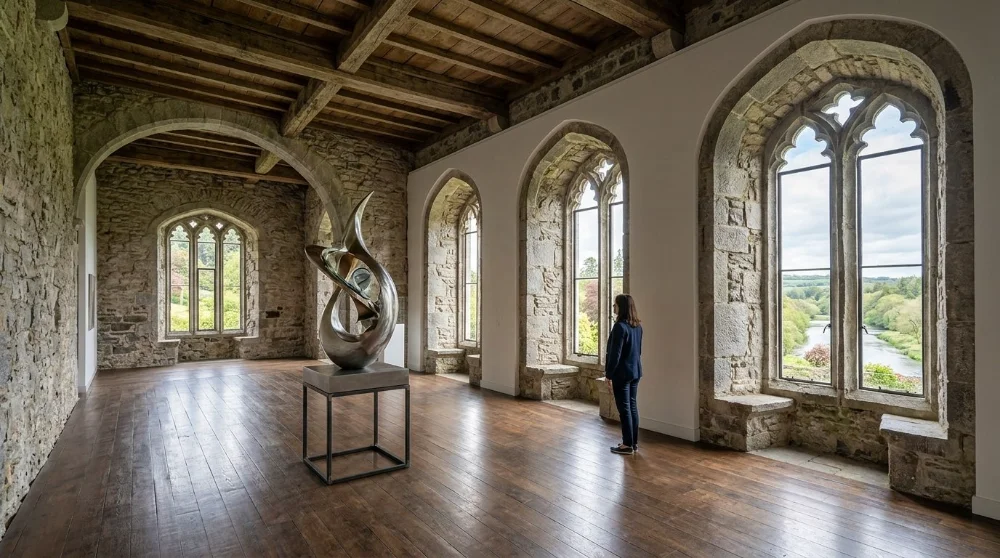
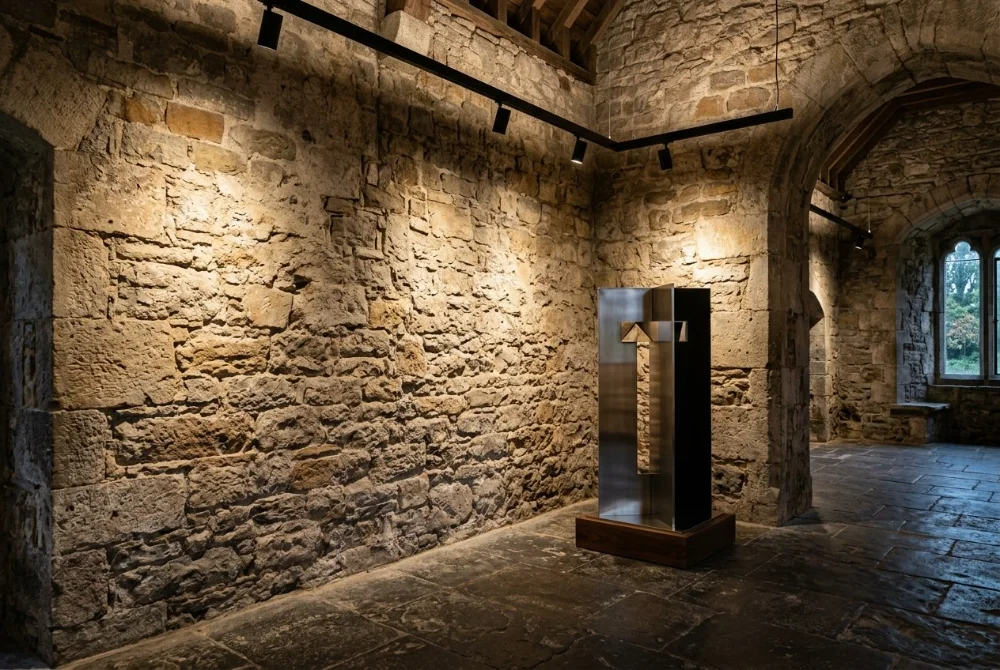
The transformation was remarkable. Where there had been decay, there emerged light-flooded spaces designed to showcase contemporary art in a modern context while still revealing the 300-year-old history of the building itself. The architects worked carefully, preserving the character of the original structure while creating a state-of-the-art gallery.
The result is a series of rooms filled with natural light, each one designed to allow visitors to appreciate contemporary art in a setting that honours the past without being trapped by it.
The gallery opened in September 2005 with an exhibition called “Individual Fields,” curated by Aileen Corkery. The show featured works by some of the most exciting names in contemporary art: Matthew Barney, Richard Long, Barry Flanagan, Gerard Byrne, Dorothy Cross, Michael Craig-Martin and Richard Billingham.
Burlington’s hope was clear. “I hope that gradually Lismore will become known not just as a place to come and enjoy art, but as an inspiration and source of future artistic creation,” he said.
A Not-for-Profit with International Ambition
Lismore Castle Arts was founded as a not-for-profit initiative. Its mission was straightforward: to present and promote contemporary visual art in Ireland. But the ambition was never small. From the beginning, the gallery set out to host exhibitions of international significance alongside smaller shows, projects and events.
Over the years, the gallery has presented the work of many leading international artists. The list is impressive: Anne Collier, Gerard Byrne, Dorothy Cross, Nancy Holt, Richard Long, Charlotte Prodger, Eva Rothschild and Ai Weiwei. Matthew Barney, Rashid Johnson, Eddie Peake and Superflex have also been part of the programme.
The gallery has hosted at least 36 exhibitions since it opened, including 17 solo shows and 19 group shows, featuring work by 176 artists.
But Lismore Castle Arts is not just about big names. It is about creating meaningful experiences for visitors and the local community.
A 20th Anniversary Celebration: The Kunstkammer Exhibition
In 2025, Lismore Castle Arts celebrated its 20th anniversary with a special exhibition curated by Robert O’Byrne, a well-known Irish writer and decorative arts specialist.
O’Byrne chose a theme that suited the castle perfectly: the kunstkammer, or cabinet of curiosities. This was a form of museum popular in Europe from the 16th century onwards, where rare and unusual objects – both natural and manmade – were displayed together.
“Periodically, there’s a wave of excitement about kunstkammers – people rediscover them, and then they fade away again,” O’Byrne said. “Maybe this is the start of a rediscovery, at least in Ireland.”
The exhibition brought together an eclectic mix of objects. Antique Chinese teak chairs sat alongside a 17th-century Italian ebonised cabinet. A taxidermy tableau from around 1900 featured boxing red squirrels. At the entrance, a copy of Ferrante Imperato’s book “Dell’Historia Naturale” – which includes the oldest engraving of a kunstkammer – was loaned by Marsh’s Library in Dublin.
Contemporary artists were well represented too. Sarah Lucas contributed dangling sculptures. Edward Rollitt created a dark mirrored installation. Urs Fischer installed small pieces in a landing cabinet usually housed in the castle.
Irish artist Sasha Sykes created a new work called “Belonging” – a travel chest made of clear resin, with flora gathered from the Lismore gardens cast inside. “If you’re talking about nature and the environment, Lismore gardens are the ultimate kunstkammer,” she said. “It’s literally a collection of curious trees and plants and things from around the world, like the magnolias from the Himalayas in the lower garden.”
The aim of the exhibition, O’Byrne explained, was not to “reflect the human condition or observations or the state of the world today” but simply to “entertain, delight and educate.”
Beyond the Castle Walls: St Carthage Hall and The Mill
The success of the main gallery led to expansion. In 2011, a second project space opened in the town of Lismore itself.
St Carthage Hall is a former church, a beautiful building with its own character and history. This gallery presents a varied programme of exhibitions, showcasing works by artists such as Niamh O’Malley, Kaye Donachie, Caoimhe Kilfeather, Matt Connors and Ailbhe Ní Bhriain. The space is wheelchair and buggy accessible, making it open to all visitors.
Then in 2022, a third space opened on the outskirts of Lismore town. The Mill brought back into use a historically significant building, and it allowed the gallery to present more physically challenging artworks that might not fit in the other spaces. Since opening, The Mill has hosted works by Virginia Overton, Carolina Aguirre, Anne Tallentire and Laura Fitzgerald.
These three spaces – the main gallery in the castle, St Carthage Hall in the town, and The Mill on the outskirts – give Lismore Castle Arts a presence that extends throughout the community.
Art in the Gardens: Sculpture Among the Magnolias
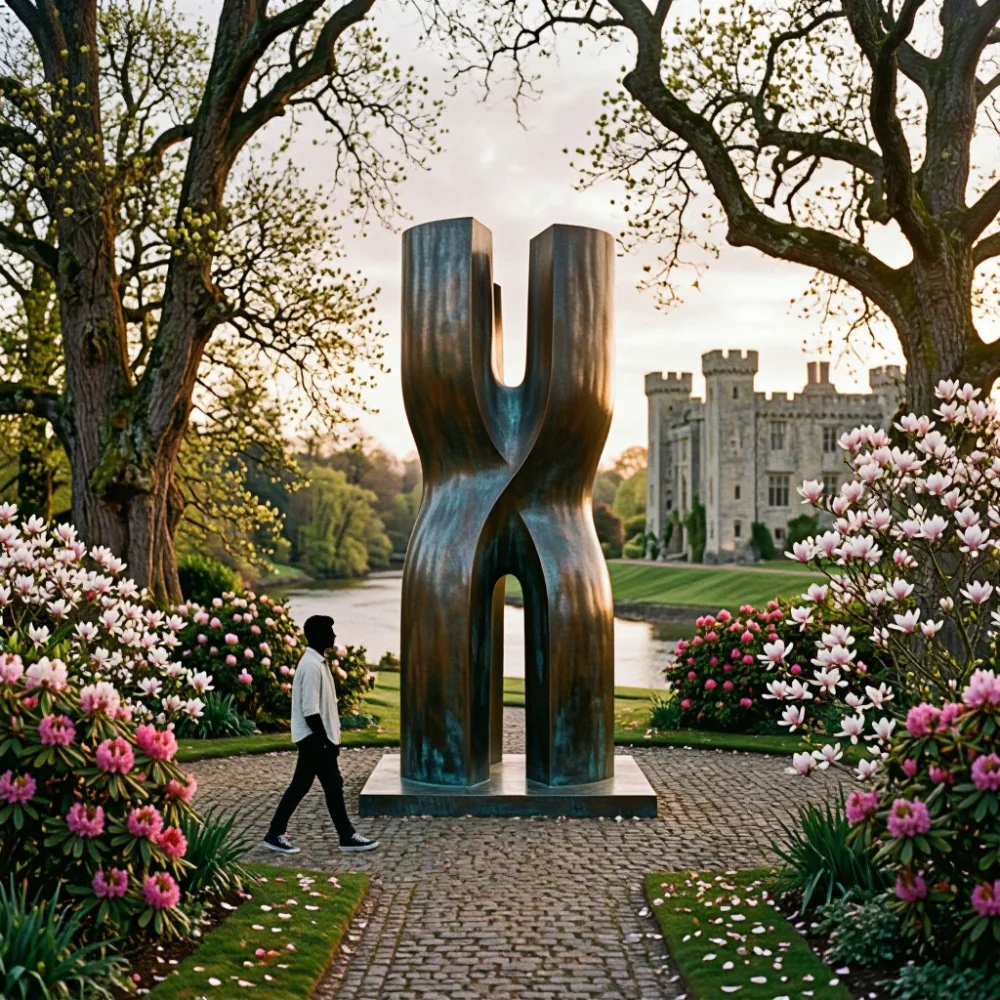
The connection between art and the castle gardens goes back further than the gallery itself. In 1999, several pieces of contemporary sculpture were installed in the gardens. Antony Gormley, best known for his “Angel of the North,” contributed work.
Today, the gardens contain permanent works by several leading artists. Roger Hiorns, Eilís O’Connell and Franz West all have pieces on display. The gardens themselves are spectacular – seven acres of ornamental borders and productive areas, with vegetables, herbs, fruit and flowers grown for the kitchen and house.
The formal terraced gardens were created by the gardener and engineer Sir Joseph Paxton and filled with exotic species such as magnolias, camelias and rhododendrons. Some sections date back 400 years.
For visitors, the combination of art and nature is part of what makes Lismore special. You can wander through the gardens, discover a sculpture around a corner, and then step into the gallery to see cutting-edge contemporary art.
A Commitment to Community and Learning
Lismore Castle Arts has never been just about exhibitions. From the beginning, the gallery has been deeply committed to community engagement and education.
The learning programme is comprehensive. School workshops are available for primary and second level students. The learning team facilitates highly creative workshops that connect young people with art in meaningful ways.
Art Play sessions for children under 5 are popular with families. Led by artist Eilis O’Toole, these sessions are inspired by the gardens at Lismore Castle and involve sensory play and art making.
Cruinniú na nÓg, a national day of creativity for children and young people, is a regular feature. In 2026, the programme included family art sessions, workshops for West Waterford primary schools and pre-schools, and sessions for a secondary school Autism Hub group.
The gallery also runs ARTifice, an annual exhibition that presents students’ artworks exploring links to manmade and natural objects inspired by the current exhibition.
And then there is “A Space for Lismore,” a long-term project that fosters collaboration between artists and communities. In 2026, artist Debbie Godsell will work with the learning team to develop a project exploring the history and experiences of Lismore women, past and present, using the new print studio as a base.
Artist Ruby Wallis held a year-long series of workshops with International Protection Applicants living in Lismore. “These conversations have become a point of connection, creativity and cultural memory, as the garden becomes a site of personal significance. It is a space for healing and growth,” she said.
The gallery is also developing a permanent sculpture yard in the former stable yard, with permanent works by Dorothy Cross and Niamh O’Malley, alongside a printing press which will give the learning programme a focus over the coming years.
Funding and Support
Lismore Castle Arts’ exhibition programme is funded by the Arts Council and Waterford City & County Council Arts Grant. This support allows the gallery to maintain its commitment to presenting ambitious and challenging work by world-renowned artists while remaining accessible to the public.
The gallery is open daily from 11am to 6pm (last entry 5pm) from March to October. St Carthage Hall and The Mill are open on Fridays, Saturdays and Sundays during exhibitions.
A Legacy of Patronage
The Devonshire family has a long history of art collecting. The family collection, held at Chatsworth House in Derbyshire, includes works by Raphael, Titian, Dürer, Rembrandt, Rubens, Canaletto, Renoir, Reynolds, Gainsborough and Freud.
Lismore Castle itself is a treasure house of art, furniture and craftwork, with a banqueting hall designed by the Gothic Revival architect Augustus Pugin.
But Lismore Castle Arts represents something different. It is not about preserving the past in a frozen moment. It is about continuing a tradition of patronage and bringing the best of contemporary culture to a new audience.
“Lismore Castle has developed throughout the ages,” Burlington said, “so there is no reason to stop that development at a particular point in history.”
A Place of Inspiration
For visitors, Lismore Castle Arts offers something rare. It is a place where history and contemporary art exist side by side, where the weight of centuries does not crush the new but provides a context for it.
The gallery itself is a work of art – a transformation of a derelict space into something light-filled and welcoming. The exhibitions challenge and delight. The gardens offer peace and beauty. The community programmes connect art to everyday life.
William Burlington’s childhood memory of the castle, grown “to almost mythic proportions,” has become something real and shared. The castle is no longer a private dream but a public gift.
“I hope that gradually Lismore will become known not just as a place to come and enjoy art, but as an inspiration and source of future artistic creation.”
Twenty years on, that hope is being realised.
Lismore Castle Arts
Lismore, Co. Waterford, P51F859, Ireland
Telephone: +353 (0)58 54061
Email: info@lismorecastlearts.ie
Opening Hours:
Lismore Castle Arts: Open Daily, 11am – 6pm (last entry 5pm), 13 March – 25 October 2026
St Carthage Hall: Fridays, Saturdays & Sundays, 12pm – 5pm during exhibitions
The Mill: Fridays, Saturdays & Sundays, 12pm – 5pm during exhibitions